Most Tuesday mornings, a small crew shows up at Mead Botanical Garden before the parking lot fills. They meet near the picnic tables past the main entrance, pull on gloves, and spend a couple of hours weeding beds and hauling mulch under Randy Knight's horticultural program. By the time the rest of Winter Park arrives for a walk on the Grover Trail or a class at the amphitheater, the volunteers are usually gone, and the 47 acres look like they maintain themselves.
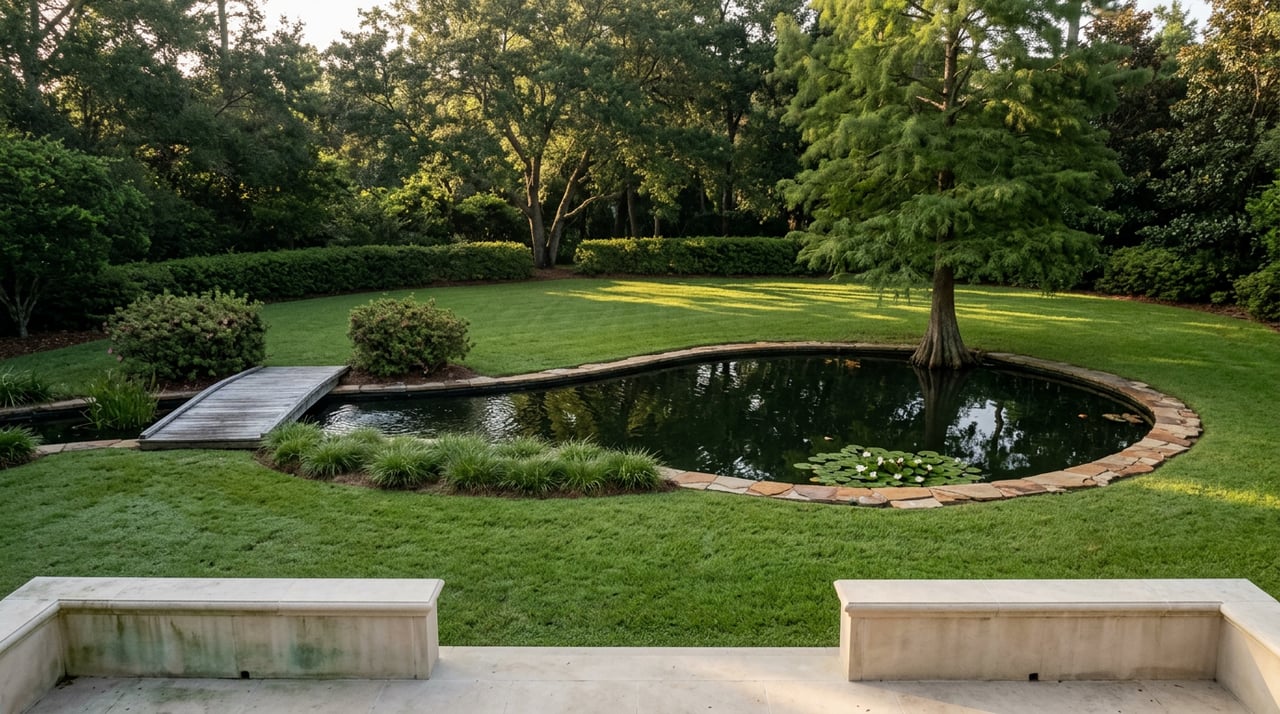
They don't. Mead Garden runs on roughly $400,000 a year, and less than $100,000 of that comes from the city. The rest is donations, rentals, memberships, and the roughly 8,000 hours volunteers put in annually. It's a nonprofit operation dressed up as a public park, and most people who walk the boardwalk past Alice's Pond, where the resident alligator likes to sun itself below Azalea Lodge, have no idea how thin the budget behind it actually is.
That's the context worth holding onto, because in late August 2026, Alice's Pond became the subject of a $500,000 state-funded project, and the reason has nothing to do with how the pond looks from the terrace. It has to do with where the water goes after it leaves.
A pond with a job
Alice's Pond sits fed by Howell Creek, the same creek the garden's founders diverted and widened back in the 1930s to connect Lake Sue and Lake Virginia when they were laying out the original grounds. What most visitors treat as a scenic stopping point on a Saturday walk is functionally the start of a watershed. The pond's outflow, crossed by a bridge near the 1956 Grover Trail monument, feeds into the broader Winter Park Chain of Lakes, the same seven-lake system that carries pontoon tours, kayaks, and paddleboards past Rollins College and the Kraft Azalea Gardens every day of the week.
State Sen. Jason Brodeur, who helped secure the funding alongside State Rep. Anna Eskamani, put it plainly when the project was announced: Alice's Pond is the headwaters to a lot of the Winter Park chain of lakes, and that water flows north into Seminole County, into Lake Jesup, and eventually the St. Johns River.
That is a wider footprint than a 47-acre city garden usually claims. The $500,000 is going toward technology designed to strip excess nitrogen and phosphorus out of the pond before those nutrients can feed the algal blooms that choke oxygen from a lake system and push out the fish and birds that depend on it. Eskamani's framing was similarly direct: the same water quality that protects boating and fishing in the chain of lakes is the water that eventually reaches a household faucet, and the same water kids play in downstream.
The garden that moved first
The timing is worth sitting with for a second reason. Just days before Mead Garden's project was announced, Harry P. Leu Gardens in Orlando postponed its own planned improvements over budget concerns. Leu Gardens is the larger, better-funded operation of the two, with roughly 50 formal acres along Lake Rowena and a much bigger civic profile than Mead's scrappy nonprofit board.
Mead moved forward anyway. Part of that is simply the funding source: this was a state legislative appropriation aimed specifically at the Alice's Pond watershed connection, not a discretionary city or county line item competing against other capital projects. But it also says something about how this particular garden has operated for most of its recent history. When the city moved its maintenance facilities out of the grounds in 2008, the emptied building didn't sit vacant. It became the Discovery Barn, home to youth naturalist programs that still run today. When The Grove Performance Pavilion needed building in 2012, roughly $700,000 came together through an anonymous $250,000 gift, $200,000 from the city, and the balance raised from individuals and foundations. Mead Garden has a track record of turning modest, patchwork funding into finished projects rather than waiting for a bigger check.
The pond itself has already been through one repair. Years before this nutrient project, the embankment between the wetland and its stormwater outflow area had eroded to the point that the original turf reinforcement mat was failing, and the city replaced it with a more permanent synthetic turf system. That fix was about erosion control. This one is about chemistry. Both point to the same reality: keeping this small pond functioning as clean headwaters takes ongoing, unglamorous work that almost nobody watching egrets from the Azalea Lodge terrace ever sees.
What doesn't pause for a construction project
None of this means the garden goes quiet while the work happens. The rhythms that make Mead Garden feel like a second backyard for a lot of Winter Park residents keep running on schedule:
- Volunteer mornings continue Tuesdays and Fridays, open to anyone who wants to show up and help with the grounds.
- Yoga in the Garden sessions are still held on the Grove Stage on a rotating weekend schedule, ten dollars a class, proceeds going back to the garden.
- The Life Explorers speaker series and Winter Park Library storytime partnership keep their regular slots for adults and young kids respectively.
- GROWvember, the garden's fall plant sale, and the Great Duck Derby, its rubber-duck fundraiser for educational programming, remain on the annual calendar.
If you've never connected any of that to a state water quality appropriation, that's the point. Most of what happens at Mead Garden is small in scale and easy to take for granted. A yoga class on a Saturday morning doesn't announce that it's happening a few hundred feet from the literal source of the lake system so much of Winter Park's identity is built around.
Why this is worth knowing if you already live here
The easy version of this story is "a local garden got some grant money." The more accurate version is that a pond most residents treat as scenery is doing double duty as the opening chapter of a watershed that runs through Lake Virginia, Lake Sue, the rest of the Winter Park Chain of Lakes, north into Seminole County, and eventually into Lake Jesup and the St. Johns River. Whatever nutrient load builds up at Alice's Pond doesn't stay at Alice's Pond. It travels.
That's a different way to think about a place a lot of people walk past without stopping. The next time you're on the boardwalk near the Grover Trail kiosk, or catching sight of the alligator sunning near Azalea Lodge, or dropping a few dollars at the Great Duck Derby, you're standing at the start of something that reaches a lot farther than the fence line suggests. Mead Garden has always run on volunteer hours and modest budgets rather than headline funding. This time, the state noticed why that matters beyond the garden's own gate.
If you're weighing what makes a place like Winter Park worth the roots you put down here, this is part of it. The town's small, chronically underfunded institutions tend to matter more than their budgets suggest, and paying attention to them is its own kind of local literacy.
If you'd like a conversation about what's happening across Winter Park, Windermere, and the surrounding Central Florida communities, from the market to the civic details that shape daily life here, reach out to Andy Williams. Let's Connect.